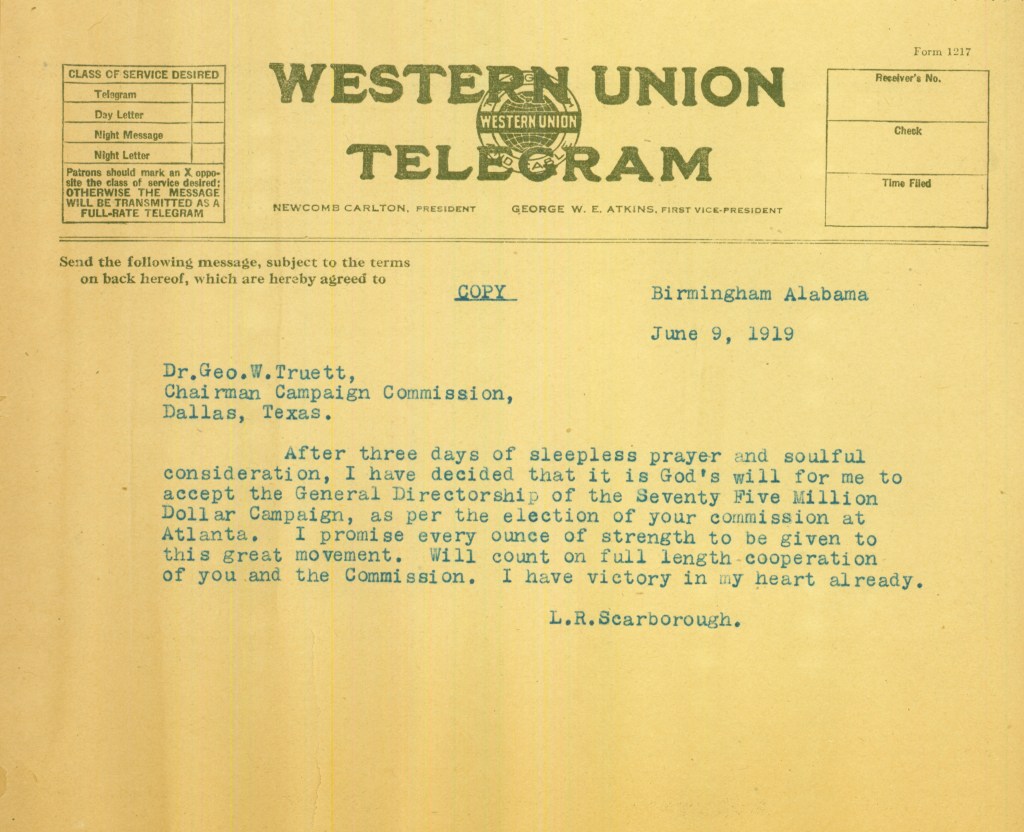
On June 9, 1919 this telegram was send from L. R. Scarborough, president of Southwestern Baptist Theological Seminary to Geo. W. Truett, pastor of First Baptist Church, Dallas. (From the Seventy-Five Million Campaign Collection in the SWBTS Archives).
What was the Seventy-Five Million Campaign and why was it important?
The Seventy-Five Million Campaign was a five-year fundraising effort launched by the Southern Baptist Convention (SBC) in 1919. Southern Baptists looked to expand missionary, educational, and benevolence work with a concentrated effort to raise funds. Leading the charge was Campaign Director and president of Southwestern Baptist Theological Seminary (SWBTS), Lee Rutland Scarborough. As this telegram details, he accepted the post after much prayer and assured victory. Cooperating state conventions were tasked with raising various agreed proportions of the seventy-five million by calling on cooperating church members to make pledges. Initially, the campaign was an unprecedented success bringing in pledges for $92 million, well over the $75 million goal. However, a financial downturn of the U.S. economy in the early 1920s made collecting the pledges increasingly more difficult. By 1925 when the campaign concluded, Baptists raised over $58.5 million. While this did not exceed the original goal, it was still substantially more than any prior fundraising effort of the SBC. Unfortunately, several receiving entities, including the foreign and home mission boards, began expansion based on pledges resulting in a deficit not stabilized until 1944. Despite setbacks, the consensus among leadership was the spiritual benefits to Southern Baptists of the Seventy-Five Million Campaign far outweighed the financial shortcomings.
This campaign was important as it brought Southern Baptists together in a unified mission, showed the potential of cooperation, and established the framework for the Cooperative Program, which continues to fund the Southern Baptist Convention and its ministries. For more information on the Cooperative Program, visit https://www.sbc.net/missions/the-cooperative-program/
Five facts you may not know about the Seventy-Five Million Campaign
- The Campaign was a marketing masterpiece.
1919 campaign efforts launched the most significant marketing endeavor seen to that point in SBC history. In the first six months, alone, over sixty-five million tracts were produced. Other marketing materials included letters, posters, pamphlets, and charts.
2. The Campaign had its own theme song.
A hymn composed in 1919 by Isham Emmanuel Reynolds, professor of music at SWBTS was adopted for use in rallies, conferences, and churches. The piece titled “When Millions Come Pouring In” was set to the melody of “Glory Hallelujah,” otherwise known as “The Battle Hymn of the Republic.”

This is a handwritten draft of the hymn from I. E. Reynolds Papers 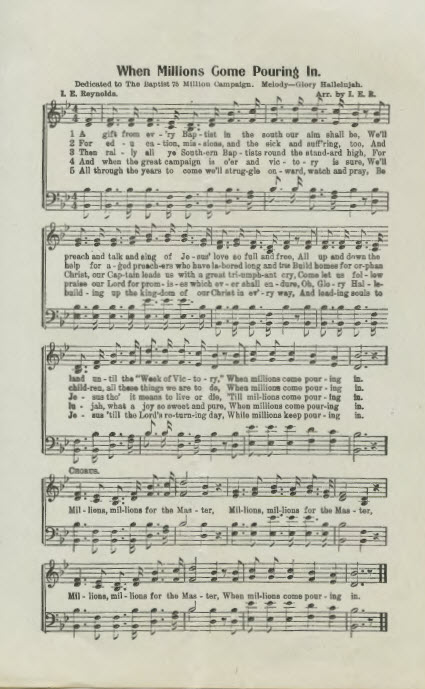
3. The Campaign incorporated a method perfected by the U. S. Government in WWI.
Reports at the conclusion of the campaign claim almost 18,000 volunteers from Baptist churches assisted in fundraising and awareness. Of these volunteers, thousands served as “four-minute speakers,” duplicating a method used to gain support for WWI. An initiative of Woodrow Wilson employed volunteers to give four-minute speeches on war effort topics. Four minutes was deemed an appropriate time frame for attracting listeners in everyday venues such as movie theaters, where coincidentally changing reels took four minutes. Southern Baptist volunteers delivered rallying four-minute speeches in churches across the country, generating great interest and enthusiasm.
4. The Campaign strengthened the role of women in denominational work.
Southern Baptist women played a substantial role in raising funds during the campaign. For the first time in its history, the SBC invited women to participate in a committee unrelated to women’s work. The Woman’s Missionary Union (WMU) promoted the campaign heavily through its publications and events. The goal pledged by the WMU was fifteen million dollars, and by the end of the campaign, they were the only faction to exceed their goal by raising over sixteen million. Southern Baptist women solidified their place within the convention for kingdom work and paved the way for generations to come. L. R. Scarborough praised their efforts stating the campaign “added an appreciation almost immeasurable of the value and effectiveness of our women as organized forces in the ongoing of God’s Kingdom.”[1]
5. The Campaign revolutionized church budgets and bookkeeping.
Prior to the campaign, many churches in the SBC did not use a systematic method for church finances. Rather, they chose to fund expenses and special projects on a case-by-case basis. The convention-wide campaign provided churches with new tools specifically for treasurers to implement a uniform budget process and aid with accurate bookkeeping. The Sunday School Board also encouraged increased teaching on stewardship and tithing, developing the foundational concepts of financial accountability.
[1] Lee Rutland Scarborough, Marvels of Divine Leadership (Nashville: Sunday School Board, 1920), 121-122
“Laymen and women, young and old were developed in the Campaign in such numbers and to such glorious efficiency that in this alone the Campaign was thoroughly justified, counting all the costs.”
L. R. Scarborough
Sources:
McBeth, H. Leon. The Baptist Heritage: Four Centuries of Baptist Witness (Nashville: B & H Academic, 1987).
Melton, Donnie G. “The Seventy-Five Million Campaign and its Effects upon the Southern Baptist Convention.” Th.D. Diss., Southwestern Baptist Theological Seminary, 1975.
Scarborough, Lee Rutland. Marvels of Divine Leadership (Nashville: Sunday School Board, 1920).
Seventy-Five Million Campaign Collection. B. H. Carroll Center, Southwestern Baptist Theological Seminary.
 Antiquarian Seminarian